


The 5-Minute Trading Strategy Test
Aug 27, 2026 /Level: Beginners /Avg reading time: 5 minutes
Did you know most prop firm evaluations aren’t lost to bad trades, but to overlooked trading strategy flaws? The good news: these mistakes are fixable. Most traders often pour months into refining their trading strategy, only to hit roadblocks like profit target mismatches, inconsistent risk management, or misunderstood drawdown rules. Compliance with prop firm trading plans isn’t just about skill, it’s about aligning your trading strategy with the rules that govern the prop firm ecosystem.
Solution: In this guide, we’re going to walk you through a simple 5-minute strategy audit to spot the hidden gaps in your trading plan, plus a free checklist to help you prepare for your evaluation. Whether you’re a scalper, a swing trader, or running an Expert Advisor (EA), this audit ensures your approach is built to pass – not fail – when the pressure is on.
With the LEVERAGED Turbo Trade Evaluation, we’ve lowered the cost of entry with our Pay After You Pass model – you start your 1-step evaluation for just $8.88, and only pay the activation fee once you’ve proven your skills.
In this guide, you’ll learn a simple 5-minute trading strategy audit to ensure your trading plan is ready for the Turbo Trade evaluation. Why tweak your trading rules blindly when you can optimize them with precision?… Let’s begin.
Key Concepts: Understanding Prop Firm Trading Rules
At Leveraged, our trading rules are designed to reward disciplined risk management. Before you test your forex strategy, you need to understand these requirements and how they shape a trading plan that’s both effective and compliant. Before you put your trading strategy to work across Forex, Crypto, Stocks, or Metals, you need to understand the exact parameters of the Turbo Trade evaluation.
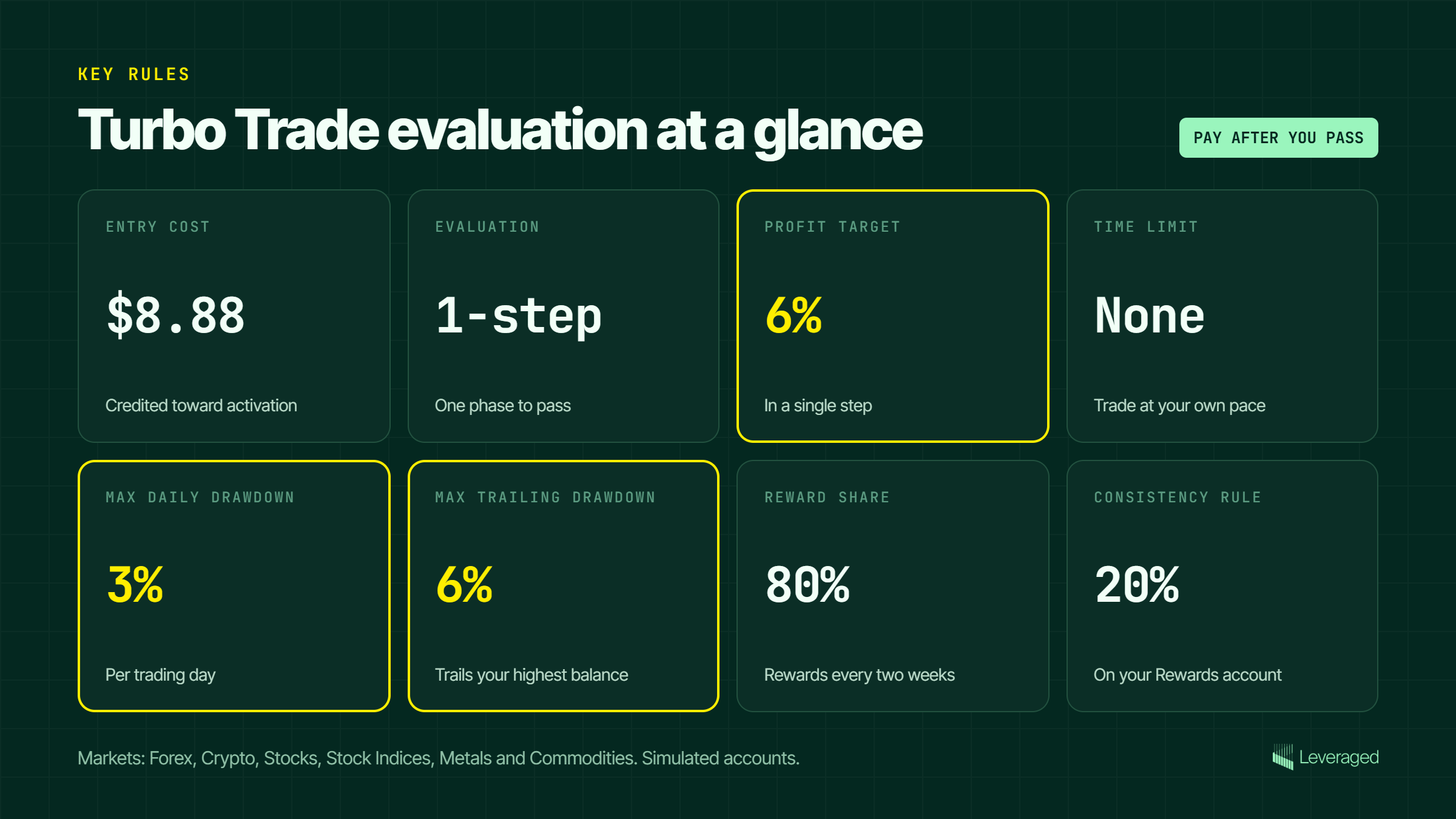
Turbo Trade Pricing & Account Tiers
You only pay the activation fee after you successfully pass the 6% profit target. The $8.88 initial fee is credited directly toward your activation.
| Account Size | Initial Platform Fee | Turbo Activation Fee (Pay After Passing)* | Crypto Activation Fee* |
| $10,000 | $8.88 | $76.12 | $80.12 |
| $25,000 | $8.88 | $180.12 | $210.12 |
| $50,000 | $8.88 | $340.12 | $390.12 |
| $100,000 | $8.88 | $540.12 | $640.12 |
| $150,000 | $8.88 | $816.12 | $980.12 |
| $200,000 | $8.88 | $1,089.12 | N/A |
*Note: The $8.88 platform fee is already deducted from the activation fees above. Activation fees must be completed within 30 days of passing.
Profit Targets: 6% in a Single Step
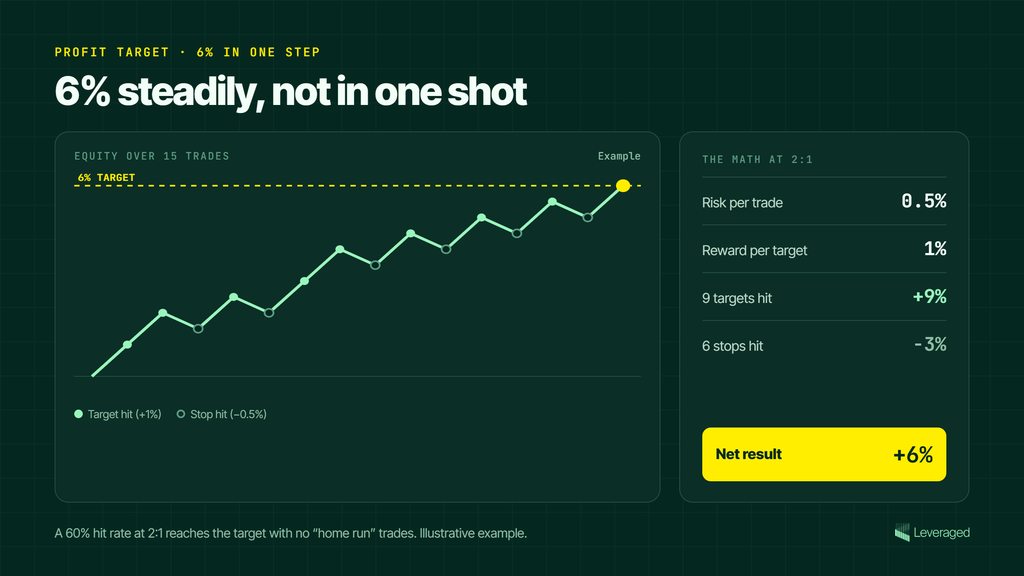
Unlike multi-phase challenges demanding 8% to 10%+ per phase, the Turbo Trade evaluation requires a clean 6% profit target in a single evaluation step.
- Why it works: You don’t need high-risk, “home run” trades. A realistic 6% target encourages disciplined risk-to-reward ratios (e.g., 2:1 or 3:1) rather than overleveraged gambles.
- Audit Question: “Can my ding strategy hit 6% steadily over 10 to 30 trades without relying on high-impact news spikes or overnight gaps?”
While this might seem modest compared to aggressive targets like 15-20%, it reflects our focus on consistent growth over reckless gambles. Why Leveraged’s 6% rule works: Strategies chasing inflated returns often self-destruct through overleveraging (Eg. 5%+ risk per trade). With our 1:100 leverage, discipline is non-negotiable, even small missteps compound quickly.
Pro Tip: Pair our 6% profit target with a 2:1 risk-reward ratio. This ensures sustainable progress while keeping equity drawdowns in check. At Leveraged, we reward traders who can replicate success across dozens of trades, not one-off lottery wins.
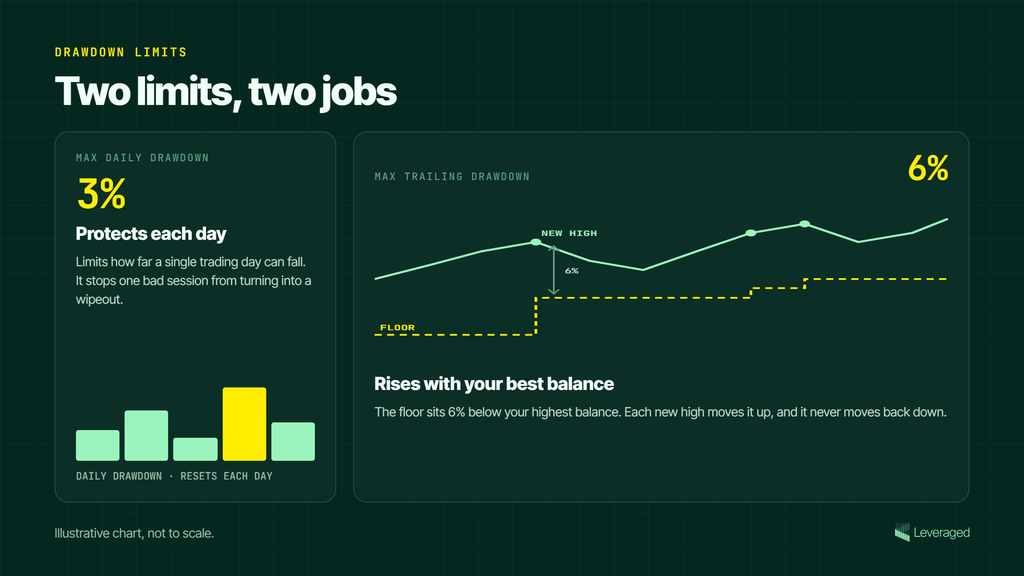
Drawdown Limits: 3% Daily & 6% Trailing
The Turbo Trade evaluation features two core risk parameters designed to cultivate institutional-grade risk management – rules that separate professionals from gamblers:
- 3% Maximum Daily Drawdown: Protects your account from intra-day tilt and single-day wipeouts.
- 6% Maximum Trailing Drawdown: Trails your highest account balance, locking in discipline as your equity grows.
Pro Tip: Because the daily drawdown limit is 3%, keep your risk per trade between 0.5% and 0.75%. That lets you absorb 4–6 losing trades in a single day without breaching the daily limit. Your trading strategy must survive losing streaks without breaching these drawdown limits.
- Red Flag: High win rates mean nothing if a single losing streak breaches 6% maximum DD. Backtest your Forex strategy against volatile scenarios (Eg: Fed announcements, geopolitical shocks) to ensure compliance. Avoid trading within 5 minutes before or after high-impact economic news releases to avoid jeopardizing drawdown limits.
- Leveraged Advantage: Unlike firms with restrictive time limits, our “unlimited days” policy lets you recover strategically after losses, but only if you respect the prop firm drawdown rules.
No Time Limits
Rushing creates mistakes. The Turbo Trade evaluation has no calendar deadline. You can take 5 days, 5 weeks, or 5 months to hit your 6% profit target. Rushing creates mistakes; trade at your own pace.
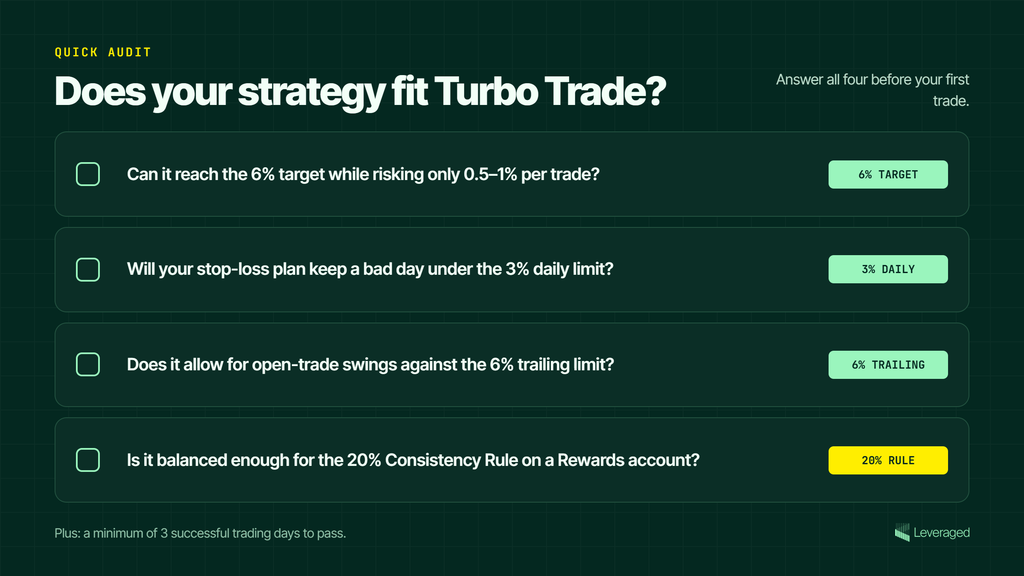
Quick Audit: Does Your Trading Strategy Fit the Turbo Trade Evaluation?
Ask yourself these four questions before placing your first trade:
- Can it reach 6% profit target without risking more than 0.5%–1% per trade?
- Does your stop-loss plan ensure you won’t exceed 3% daily drawdown during a losing streak?
- Does your strategy account for the 6% trailing drawdown during open equity fluctuations?
- Is your system balanced enough to comply with the 20% Consistency Rule once you reach your Rewards account?
At Leveraged, we’re not just evaluating your trades, we’re testing your ability to thrive under the rules that define professional trading and maintain consistency. While most prop firms impose rigid minimum trading days, we require just 3 successful trading days – lower than industry standards – to validate consistency without unnecessary delays.
5-Minute Trading Strategy Tips to Pass the Turbo Trade Evaluation
Learn how legendary traders like Paul Tudor Jones, Linda Raschke, and Steve Cohen refine their trading strategies – and how you can adapt their trading principles to pass prop firm evaluations.
Tip One: Trade Small to Protect the 3% Daily Cap
“Risk less than 1% of your trading account on a trade.” – Ed Seykota
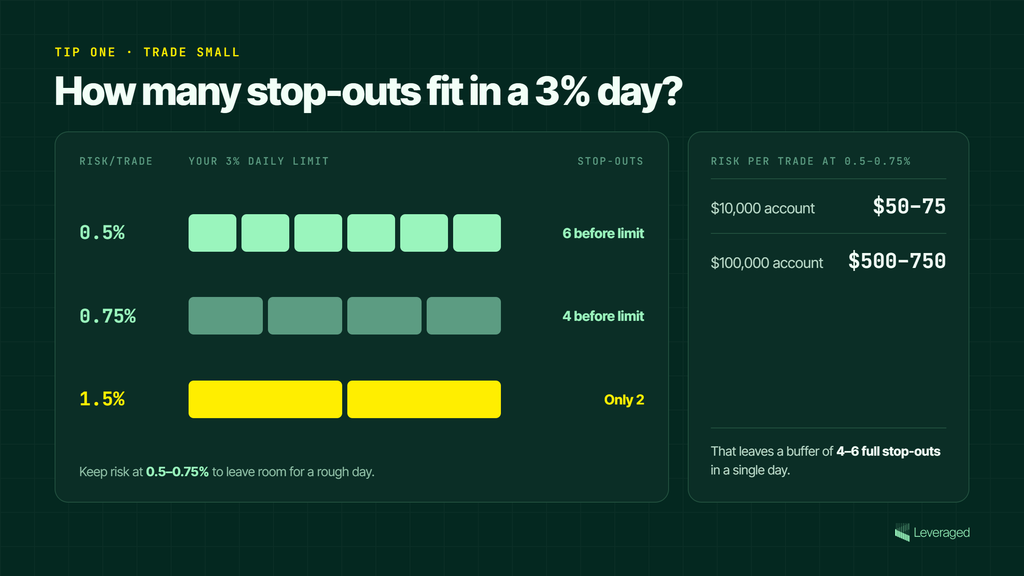
Risking more than 0.5 – 1% of your account balance per trade is a fast track to breaching the challenge’s rules. With a 3% daily limit, risking 1.5% or 2% per trade is dangerous. Keep your risk per trade between 0.5% and 0.75%:
- On a $10,000 Turbo Trade Account: Risk $50 – $75 per trade.
- On a $100,000 Turbo Trade Account: Risk $500 – $750 per trade.
This gives you a buffer of at least 4–6 consecutive full stop-outs in a single day before threatening your account.
Tip Two: Master One Setup and One Instrument First (One Good Trade at a Time)
“A jack of all trades is a master of none.” – Anonymous
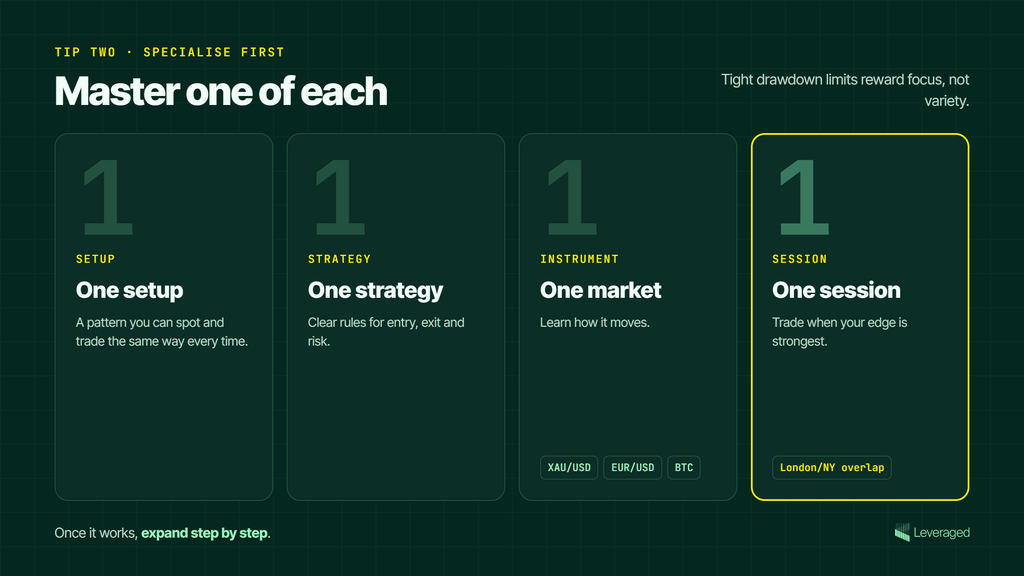
Specialization beats diversification when working within tight drawdown parameters. Whether you focus on Gold (XAU/USD), EUR/USD, or Bitcoin, stick to the market and the trading session (e.g., London/NY overlap) where your trading edge is highest. Focus on mastering one trading setup, one trading strategy, one trading instrument, one trading session.
Once you’ve mastered one market, expand step by step. A forex trading strategy that works in one market and repeatable condition, is a solid base to test in others. Many professional traders, such as Linda Raschke, are known for focusing on a small number of setups, only traded the same 3 candlestick patterns for 30 years.
Tip Three: Trading Journal – Run a Weekend Trade Audit
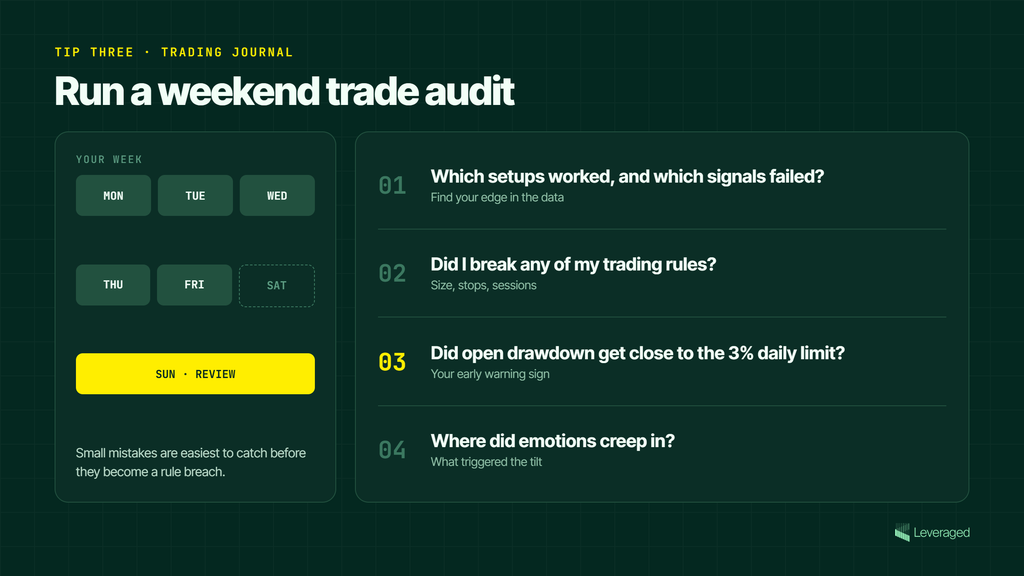
Nobody wants to review their losers/winners on a Sunday, but that’s where the trading edge is. Self-auditing and weekly reviews expose patterns like overtrading after losses and helps you catch small trading mistakes before they cause a rule breach. Here is what you need to do, every weekend, analyze your trades and ask yourself:
- “Which trading setups worked and which trade signal failed?”
- “Did I break my trading rules?”
- “Did open floating drawdowns come close to the 3% daily limit?“
- Or… “Where did emotions creep in, what triggered going on tilt?”
Tip Four: Perfect Your Trade Entries
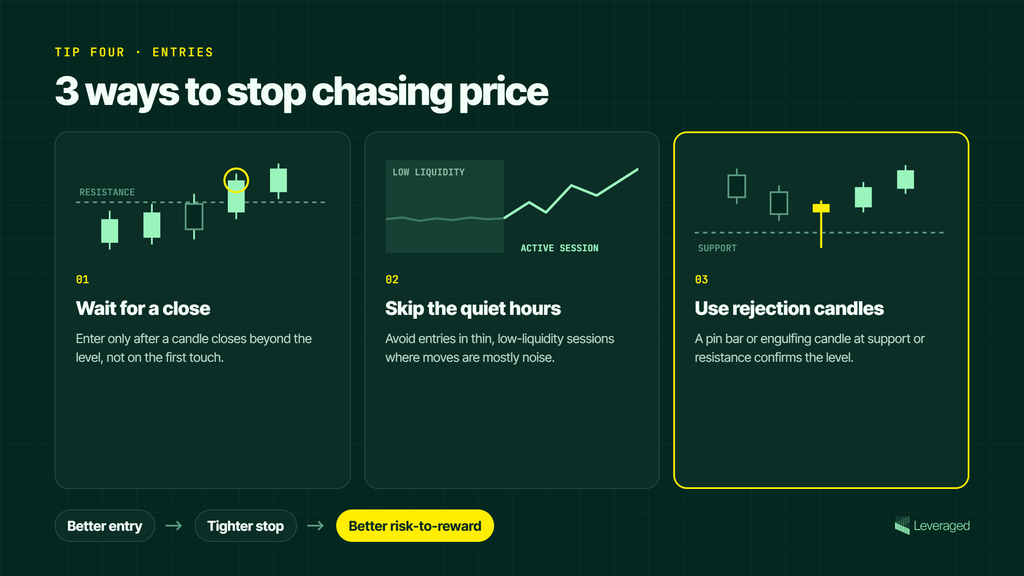
A great entry point can turn mediocre trades into winners and turn unprofitable trading strategies into rule-compliant systems. Most traders jump in too early or chase the price due to FOMO (fear of missing out). Buying or selling at the “right price” reduces the stop loss, protects your account, increases the RR ratio and keeps you within prop firm drawdown limits. How to fix it:
- Wait for confirmation: Enter only after price closes beyond a key level (Eg. a daily resistance zone or 200-period moving average).
- Avoid “noise” trading sessions: Steer clear of entries during low-liquidity sessions like the Asian forex market.
- Use rejection candles: Enter after a pin bar or engulfing pattern forms near support and resistance levels.
Common Mistakes to Avoid During Your Evaluation
Even the best trading strategy can fail prop firm evaluations if it ignores these common pitfalls. Steer clear of these errors to protect your FX account and pass your prop firm evaluation.
Mistake One: Ignoring the Consistency Rule
The Problem: Traders often focus on hitting profit targets quickly, assuming speed equals trading skills, but at Leveraged, we prioritize sustainable wins not a single “hero trade.” We don’t restrict daily profit percentage, but we do require 3 successful trading days to pass your prop firm trading evaluation.
Example: A trader aggressively forcing trades to hit the profit target goal in just 1 day, ignoring market conditions. While they technically “passed” the challenge, they failed to demonstrate trading consistency for long-term consistency in a Rewards account aka. minimum 3 successful trading days.
There is a simple solution to fix this: trade smaller position sizes to avoid overexposure on single days. The 3-day minimum is proof that you can replicate your trading success repeatedly which mirrors how professional traders mitigate impulsive risk taking.

Mistake Two: Overleveraging to “Catch Up”
The Problem: After a losing streak, traders often risk 3%+ per trade to recover losses, a guaranteed path to breaching the account fast.
Example: Risking 3% on a EUR/USD trade to win back $1,000 in losses.
Solution: Use a lot size calculator to enforce your 0.5–0.75% risk rule, no exceptions.
Loss and Gain Recovery Table
| Loss (%) | Gain to Recover (%) |
| 10 | 11.1 |
| 20 | 25 |
| 30 | 42.9 |
| 40 | 66.7 |
| 50 | 100 |
| 60 | 150 |
| 70 | 233.3 |
| 80 | 400 |
| 90 | 900 |
Mistake Three: Ignoring Real-Time Trading Strategy Feedback
The Problem: Many traders skip testing their strategy against current market conditions and prop firm rules, assuming what worked before will work now. Markets change, and strategies that worked in the past can fail today, or break key evaluation rules. The Fix: Start with an evaluation account, learn fast, and scale.
Example: Use Leveraged’s $10k Turbo Trade evaluation to:
- Test your trading strategy against live prop firm rules (drawdown, consistency, profit targets).
- Get free advanced AI analysis tools.
- Refine your approach, and once you pass, earn rewards based on your simulated performance.
Why It Works: You’ll learn faster in a rules-based evaluation than in endless backtests.
Mistake Four: Letting Emotions Override Rules
The Problem: Abandoning your prop firm trading plan during FOMO or fear leads to blown trading accounts.
Example: Trying to win back a loss with an oversized trade, only to breach the drawdown limits.
Solution: Be consistent, enforce discipline.
Case Study: How the Gold Queen Trades Within the Rules
Rules make more sense when you see them in a real account. One of the best examples on our blog is a Leveraged Trader from Slovakia we call the Gold Queen, who has now earned 11 rewards totalling $30,480. Read her full story here. Her latest cycle was on a $150K Turbo Trade Rewards account: 274 trades in 21 days, almost all on gold (XAU/USD). Here’s how her results line up with the audit in this guide:
- Small losses, protected limits: Her biggest single loss was $1,724, about 1.1% of the account, and her deepest drawdown was just 1.3%. That’s the kind of risk control the 3% daily and 6% trailing limits are designed to reward.
- A red day isn’t a breach: Her worst day, −$4,226 on 31 July, came close to the 3% daily limit, which shows why per-trade risk matters so much. Even so, every week of the cycle closed positive, because she followed red days with disciplined recoveries instead of revenge trades.
- One market, deep focus: Almost every trade was on XAU/USD, and her strongest results came between 13:00 and 14:00. That’s Tip Two in action: master one instrument and one session first.
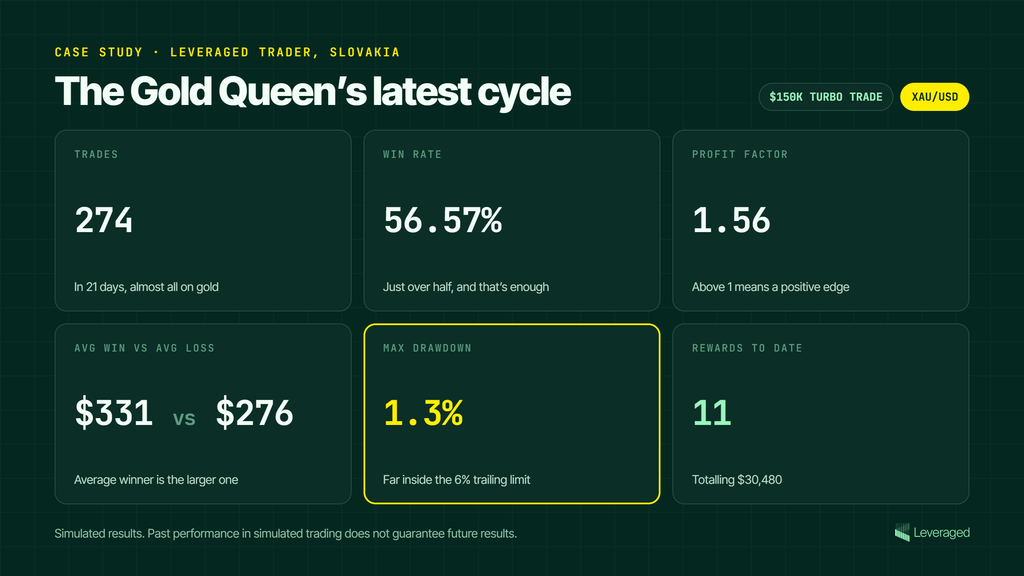
Key trading stats (simulated):
- Trades: 274 in 21 days, almost all XAU/USD
- Win rate / profit factor: 56.57% / 1.56
- Average win vs average loss: $331 vs $276
- Maximum drawdown: 1.3%
- Rewards to date: 11, totalling $30,480
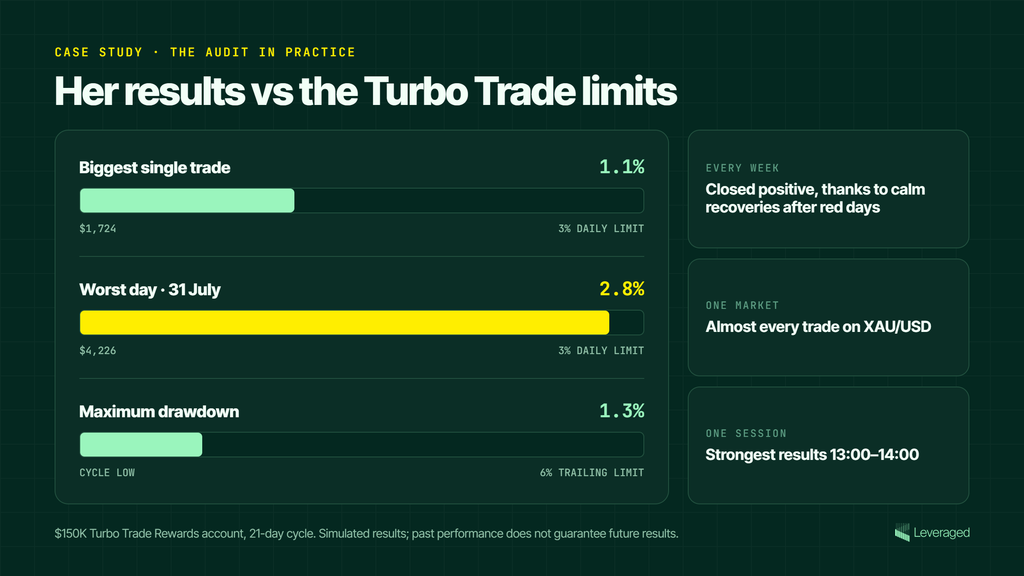
Final Takeaway: Her results don’t come from never losing. They come from keeping losses small, sticking to one market, and reviewing her own data to find what works. That’s the same audit this guide walks you through.
Simulated results. Past performance in simulated trading does not guarantee future results.
Final Words
Crafting a profitable trading strategy is only half the battle – consistency and adhering to the prop firm rules is what gets you through an evaluation. By auditing your trading plan for profit targets, drawdown limits, and the consistency, you’ll avoid the pitfalls that cause most evaluations to fail..
Passing a prop firm evaluation doesn’t require complex indicators or excessive risk – it requires alignment with the rules. By pairing a 0.5%–0.75% risk model with the Turbo Trade evaluation’s 6% profit target and unlimited time horizon, you give yourself the best chance of passing. Remember:
- Compliance beats greed: A 2% daily gain beats a 10% “hero trade” that can violate prop firm rules.
- Automate discipline: Checklists, alerts, and calculators remove emotion from the equation.
- Use the AI Analysis tools offered to Leveraged traders.
Don’t leave your prop firm evaluation to chance. Download your free eBook to refine your trading strategy, then start your Turbo Trade evaluation and take your first step towards becoming a Leveraged Trader.
FAQ
What is a good trading strategy for a prop firm?
A top trading strategy for prop traders is disciplined swing trading, where positions are held for days to capitalize on trends while adhering to strict risk limits and avoiding overtrading.
Is it good to trade with prop firms?
Prop firm evaluations let you prove your skills on a simulated account instead of trading your own savings. At Leveraged, Leveraged Traders can earn rewards based on their simulated performance, with access to AI-powered analytics, education and a trading community.
How do you trade for prop firms?
A trader typically starts by applying to take a firm-sponsored evaluation or challenge process. They need to prove their trading skills by meeting profit targets without exceeding a strict drawdown limit. If you pass, you become a Leveraged Trader and unlock a simulated Rewards account, where you can earn rewards based on your simulated performance.
What makes the Turbo Trade program different from traditional prop evaluations?
The Turbo Trade evaluation uses a Pay After You Pass model. Instead of paying hundreds upfront, you pay only $8.88 to cover platform costs. You only pay the activation fee after successfully hitting the 6% target within the drawdown rules.
What are the drawdown limits during the evaluation?
The evaluation requires you to stay within a 3% Maximum Daily Drawdown and a 6% Maximum Trailing Drawdown.
Is there a time limit to hit the 6% profit target?
No. There are no time limits. You can trade at your own pace and take as much time as you need.
When do I receive rewards?
Funded traders receive an 95% reward share, processed bi-weekly (every two weeks) via secure bank transfer.
Check out what successful traders have to say about psychology and strategy:
See how Elie used discipline, risk management, and consistency to earn a $6,802 reward.
See how Quan focused on consistency over big wins to stay consistent and pass his evaluation.
Watch how Khalid built discipline after repeated setbacks to become a Leveraged Trader and start receiving rewards.